Many people come to Antarctica in the hope of seeing wildlife. The vast majority of Antarctica has no wildlife. McMurdo has some, but it is not exactly teeming. There is a grand total of five species of terrestrial animal that one has a chance of seeing and none of them are really terrestrial since they all depend on the ocean. After the sea ice melts then it is possible that various types of sea life will be spotted, but that only comes near the very end of the season when most people are either too busy unloading the cargo ships or have already gone home.
My job allowed me to see quite a bit of wildlife since I work on the sea ice which is where most of the animals spend their time.
By far the most common wild life seen by anyone on station is the skua. Skua are a large seabird that looks a lot like a big grey seagull. They are both hunters and scavengers and very intelligent. It is not uncommon to see one swoop down from the roof of the cafeteria and knock a tray of food out of the hands of an unsuspecting resident heading back to their dorm. They are smart enough to know the difference between a tray of chicken and a tray of veggies, and the owner of the tray of chicken should beware. Even though McMurdo provides easy scavenging, their primary food source is fish. They come to McMurdo to breed and like most birds they breed in an area with few predators and plentiful food. Their only predators in the Ross Sea region is themselves and they have been know to eat their own eggs and even their own young. Due to the ocean being frozen their main source of food(fish) is not available. They instead feed on the placenta of pupping weddell seals and eggs and young of adelie penguins. The largest nesting sites are located directly adjacent to the largest penguin rookeries.
The grinch steals lobster.
A very lucky skua takes off with an unlucky residents Christmas lobster.
An angry skua with McMurdo in the background. It is difficult to hike some trails during nesting season without a skua making its presence known.
While most of the McMurdo population looks at these birds as a nuisance, I came to enjoy them. This bird nests farther south than any other bird. They spend the Austral winter off the coasts of North America making their annual migration up there with one of the longest of any birds. They are rarely seen in North Amercia because they are primarily a sea bird.
Skua mom and chick.
A skua showing its territorial display.
A skua chick.
A dead skua chick and its mother. This mother sat on the dead chick and a frozen egg for over two weeks.
A close up of the egg and the chick. A tiny beak is visible poking out of the frozen egg.
It is important to note that my photos of these birds were shot from a long way off and the photos of the birds attacking me were shot when working directly with science groups, or when walking on open trails near McMurdo Station. As soon as the birds showed aggressive behavior I left the area immediately. The photos of the nestling were shot with a telephoto lens and at no point did the parent bird react to my presence. In other words: No birds were harmed in the making of these photos.
The emperor penguin is the most iconic of the antarctic species. Luckily for most McMurdo residents they are fairly common. Groups of them wander around the sea ice close to station. They are curious birds and therefore anyone working on the sea ice within sight of an emperor is likely to be visited. On their feet they are clumsy and awkward but they do seem to be able to travel reasonably quickly.
In the water they are an amazing animal that swims incredibly fast and can dive to depths that are difficult to imagine. One was recorded at over 500 meters under water. They spend large amounts of time out of the water. There is no food out of the water so they do not eat for very long periods. This includes almost the entire winter for the male birds.
A pair of emperors who visited while doing sea ice work.
This bird spend several weeks near the airfield on its own.
Emperors come to visit.
If the emperor penguin is the statesman of the antarctic the adelie penguin is the jester. Adelies are smaller than the emperor and seem to walk around the ice with no rhyme nor reason to their travel. Like the emperors they are curious and will come and investigate anyone working on the ice.
Adelie penguins traveling from Cape Royds to the open ocean.
A group of adelie penguins at Cape Royds.
A group of adelies investigates our activities while measuring a crack near Cape Evans.
Several Adelie penguins were seen near McMurdo Station later in the season. This was shot at Hut Point.
Adelies investigate a Weddell seal on the sea ice.
Weddell Seals There are many Weddell seals all around the sea ice surrounding McMurdo Station. The seals can be found at cracks in the ice, where they work to keep holes open by chewing on the ice. Many of the seal holes have blood around them from the males who guard their holes from other males. It is not uncommon to see bloodied male seals outside the holes covered in snow having not appeared to move for many hours. These seals are exhausted from fighting for their holes. As soon as they are rested they return to the water to continue to guard the hole. From this blog post it might be easy to get the idea that we are walking next to the seals every day but this is not the case. My job did not bring me close to the seals that often, mostly because we are encouraged to stay away so we do not disturb them. Most of the time the seals are just a dark spot on the ice in the distance, occasionally my job brought me close enough to shoot some nice photos.
A male seal with a large wound on its side.
A seal pokes its head through the ice.
Using its teeth to make the hole larger.
A young seal trying to return to the water. We were tasked with blocking its way due to explosives being used underwater close by. We stood guard by this hole for a couple of hours until the explosives were used and then let the seal go about its business.
Mom and pup
A very large seal in flat light.
The final animal that one might see on Ross Island is the snow petrel. It is a beautiful white bird that I never managed to get any where close to. I saw them once and the photo was not good, but here it is.
Snow petrels above Castle Rock.
Once again it is important to note that all of the photos I have here were shot while working directly with science groups, or while doing my job. The Antarctic treaty states that people may not change the normal behavior of animals in any way unless there is a scientific purpose.
This is part 3 in a series of working and living in McMurdo. See part one here and part 2 here. Science
Emperor Penguins are just one of the many things being researched around McMurdo Station.
There are several reasons for the United States to have permanent stations in Antarctica. The first and most commonly mentioned is that they are a station for science to take place. This is true, and yes lots of science does take place at these stations. There are other reasons for the United States to have such a large presence in Antarctica also. One is that the United States and every other nation who has a presence wants to have a presence. It should be looked at as a bird in the hand scenario. To be building stations in Antarctica is to stake a claim of part of the continent if the Antarctic treaty were to ever collapse. Having the biggest presence on the continent, the United States sees itself as a defacto enforcer of the Antarctic treaty. The Antarctic Treaty says that a countries presence on the continent must have a scientific purpose, so the United States throws a lot of money at science in order to keep its presence in Antarctica, or the United States has a large presence in Antarctica because the believe that scientific research on the southern most continent is very important. As far as I am concerned the reasons don't matter. What matters is the United States and the National Science Foundation is a leading the way in funding some amazing scientific projects and living and working along side the people doing this research is one of the best things about being in McMurdo. I could not possibly do most of these projects justice by trying to describe them on this blog, but what I have done is posted some links to information about some of the groups I know about some of whom I worked with, some whom I talked with and some whom I never met at all. This is a very brief list. There were many more projects last season.
Sampling deep inside a steam cave on Mt. Erebus, Antarctica.
Thermal imaging is used to find the hottest areas of soil.
WISSARD Project:
Wissard is a project that is drilling 800 meters through the Antarctic ice to investigate and sample water and sediments underneath.
http://www.wissard.org
Long Duration Balloon:
http://www.nasa.gov/centers/wallops/news/antarctic2012.html
B-009 - Weddell Seal Science
http://weddellsealscience.com
Exploring the bottom of Antarctica food chain
http://earthref.org/ERESE/projects/GOLF439/2012/
Penguin Research:
http://www.penguinscience.com/
Weather
Antarctica is cold, but you probably already knew that. What surprised me was just how cold it can be. After doing seven climbing trips to the Denali area I did not think the cold would be that much of an issue. It is. It can be an issue for everyone and everything we do. It is so much colder than anywhere else I have ever been that I was a little surprised by it. I arrived in McMurdo on October 1st. October is a pretty cold month, but it starts to warm up quite fast as the 24 hour day light gets closer. December can actually be quite warm and I found myself walking around McMurdo in a t-shirt on numerous occasions. Keep in mind by warm I mean close to freezing. Due to the dry air and the solar radiation a temperature close to 0 degrees C can feel quite warm if the wind is not blowing.
There is a daily weather forecast at McMurdo which is about as accurate as one might think(not really).
Unlike the US, Antarctica does not have that many weather monitoring stations so figuring out what is happening with weather a day or two out can be difficult. If stationed at a field camp it is possible to call into McMurdo to get the forecast for your camp but the inevitable answer from the weather folks comes in the form of the question "well, what is it like there now?"
There are three categories of weather in and around McMurdo:
Condition 1
Windspeed over 55 knots (60 miles per hour)
Visibility less than 100 feet (30 meters)
Wind chill below −100 °F (−73 °C)
Description: Dangerous conditions; outside travel is not permitted.
Condition 2
Windspeed of 48 to 55 knots (55 to 63 miles per hour)
Visibility 1/4 of a mile to 100 feet (402 to 30 meters)
Wind chill of −75 °F (−60 °C) to −100 °F (−73 °C)
Description: Unpleasant conditions; outside travel is permitted but not recommended.
Condition 3
Windspeed below 48 knots (55 miles per hour)
Visibility greater than 1/4 of a mile (402 meters)
Wind chill above −75 °F (−60 °C)
Description: Pleasant conditions; all outside travel is permitted.
At no time in my five months on station did I experience a condition 1 at McMurdo. I did experience weather that would fit into that category while on Mt. Erebus however.
Antarctica is dry. Very dry. Most people think because there is a lot of snow and ice that it must snow a lot. It does not. Most of antarctica is considered a desert. Most of the snow McMurdo Station gets is from ocean moisture. The air is very dry and sleeping with a humidifier in dorm rooms is very common.
Antarctica is pretty windy. It is notorious for its winds, however winds in McMurdo are often not too bad. McMurdo does not get the catabatic winds that many other places do. Winds are fairly common out on the ice shelf where we teach our happy camper courses. Wind makes it feel colder, and makes it more likely you will get frostbite.
I was lucky enough to be out at the Scott Base pressure ridges when a storm was rolling in. Major storms usually come from the south.
A storm rolls across the ross sea toward McMurdo Station.
Fata Morgana stretches the base of the Royal Society Mountains.
Ice Cave
The Erebus glacier tongue is the end of the Erebus glacier that comes off Mt. Erebus. The glacier tongue floats on the ocean and extends a couple of kilometers from land. Due to the constant glacial movement of the tongue pushing out to sea, the sea ice around it contains several cracks that are often challenging to deal with. This makes it a perfect place to teach the field sections of sea ice courses. It was during one of these courses that we noticed a small hole in the wall of the glacier. The next day while conducting some sea ice monitoring we dug out the hole to find an incredible cave. This cave and others like it, are formed when crevasses in the glacier become covered by snow bridges. The surface melt water then percolates through the roof creating icicles. These caves are often used as a recreational outing for the people in McMurdo Station, but this year a lack of suitable vehicles to transport people, in addition to other things meant that very few people would be allowed to see this amazing natural wonder.
Entering the ice cave for the first time.
Some features are beyond explanation. I would love to know the dynamics behind the formation of this icicle.
It had always been a dream of mine to visit Antarctica. The reality of that dream was often realised by looking at the cost of travel to Antarctica and the knowledge that even if I could afford it, I would likely end up stuck on a boat unable to do the types of things I really wanted to do. Last year I was offered an opportunity that I could not refuse--to work as a field trainer for the US Antarctic Program. This would allow me a trip to Antarctica, and the ability to get paid for it. It was not until I got my first glimpse of the Antarctic continent that I truly believed I would get to Antarctica. The Antarctic Program had not sent me my ticketing information to New Zealand, a required stopover, until less than 24 hours before my scheduled departure time. Thus, even once we were in the air, leaving New Zealand behind, I still believed it was entirely possible this last flight might actually take me somewhere other than Antarctica.
Flights to Antarctica are done mostly with US Air Force C-17s. New Zealand and Australia also help out by adding couple of additional passenger aircraft in early and late season when large amount of people are moving back and fourth. We flew down in a chartered Australian Airbus A-319.
Landing on the ice runway.
We landed at McMurdo Station or, more specifically, on the sea ice about 2 miles outside of McMurdo Station. McMurdo is the main US research station in Antarctica and also the biggest. It is located on Ross Island very close to where Robert Scott built his first hut in 1902. The station is so close and now so large, outward sprawling like every other American city, that the Scott hut almost feels like a part of the station. It was originally built by the US Navy. The US Antarctic Program (part of the National Science Foundation) now runs the station since its sole purpose under the International Antarctic Treaty is scientific research. Although I do poke a little bit of fun at the expense of large government entities, I do truly respect the science that takes place in Antarctica and believe that it is invaluable to this and future generations.
Robert Scott's Discovery Hut
The sprawling metropolis of McMurdo Station.
McMurdo houses somewhere between 150 and 1,200 people depending on the time of year. When I arrived, there were about 300 people on station. Within several weeks that number grew close to 800 people including support staff and scientists. During the winter a core group of about 150 people keep the station running, but there is very little science underway. The support staff at McMurdo consist of everyone from janitors and mechanics, to fuel handlers and IT people. Imagine a totally isolated city with lots of heavy equipment, an airport (or two), a sewer treatment facility, a garbage sorting facility, a fire department, a cafeteria, gym, helicopter hangers, an amazing scientific laboratory, and even two bars. For each part of this small town there has to be a person to keep it running. Housing is another story. Everyone is housed in dorms, two to a room much like college.
Fuels employee refueling an LC-130.
My job, "Field Instructor," in the Field Safety Training Program (FSTP) consists mostly of teaching survival courses to every person who is going to leave the station for field work. Much like a cold weather camping class we teach setting up tents, lighting stoves, and digging survival trenches. Survival trenches are basically a shallow grave dug in the snow in which to die in if all else is lost. They will, however, allow you to live slightly longer than if you did not know how to dig one so they remain part of the curriculum. In addition, we put the students through some scenarios, one of which we call bucket head, where the students attempt to find a missing person with buckets on their heads to simulate a whiteout. So as not to forget that this is a government-sponsored entity we also cover many of the protocols of McMurdo Station which take about as much time as the survival training. The course is a two-day course affectionately referred to as Happy Camper. Each participant gets to spend the night camping outside in Antarctica on the McMurdo Ice Shelf while we, the instructors, sleep several hundred yards away in a hut warmed with a diesel burning stove that even on the lowest settings makes us wish we were sleeping outside also.
Setting up a Scott Tent on the McMurdo Ice Shelf.
A well-built happy campers camp with Mt. Erebus in the background.
Bucket head
Sun dog over Mt. Erebus as seen from happy camper on the McMurdo Ice Shelf.
Happy campers are not the only course we teach. Trainings are a key part of the US Antarctic experience, and anyone who has to do anything must take a training in order to do it. If you are going out on the sea ice you must take sea ice training. If you are going to altitude, and most of Antarctica is at high altitude, you must take altitude training. FSTP teaches both of these. In addition we provide specialized technical trainings for science groups going to glaciated areas of the continent. Other required trainings include driving snowmobiles (basic and advanced class), Hagglunds training, Piston Bully training, chainsaw training, and light vehicle training. Light vehicle training is a two-hour class that explains how to drive a pickup truck at less than 5 mph, check the oil, and place a wheel chock any time you park it. This is all done via a Microsoft PowerPoint presentation while the trucks are parked safely outside with their wheels chocked.
In addition to trainings FSTP is also responsible for establishing travel routes on the sea ice for science teams to travel to and from dive huts and Weddell Seal breeding areas. This is amongst other things that I will get to later. Route work consists of flagging routes, and monitoring the sea ice and known crack crossings for safety. This sea ice work is conducted in the early season when it is cold. Working on the sea ice can result in some of the most fun days and also some of the worst. Overall enjoyment of sea ice work depends on weather, and, as most people probably know, Antarctic weather can be fairly bad. Antarctica may not have a lot of wildlife outside the water, but what it does have is most likely to be found while working on the sea ice. Weddell seals are often laying on the ice near the cracks that FSTP monitors, and occasionally penguins wander over during the work. Penguins are drawn to pretty much anything else that is moving on the ice so if they see you they almost always come to investigate. More on penguins and seals later...
A not so good day of sea ice work.
Drilling holes to measure ice thickness.
Lunch break.
FSTP and members of our Kiwi (New Zealand) equivalent are also responsible for search and rescue. Each Thursday the team trains together. Training days consist of whatever we deem necessary to become a more effective search and rescue team. Throughout the course of a season, we step in and out of helicopters while they are hovering under full power, we set up pulley systems for an entire day, and climb around Castle Rock (one of the few recreational outings available to staff). One of the more interesting parts of search and rescue in Antarctica is the tools available to us. A lost person in an Antarctic storm would be next to impossible to find using standard search and rescue techniques. FSTP uses three Hagglands amphibious vehicles. These vehicles are meant to float if we drive them on to ice too thin, but due to a lack of spare parts neither the door seals or the pumps work in any of them, dooming them to the bottom of the Ross Sea if we were to ever drive them into the water through thin ice. Roof hatches will allow us to escape out the top as the Hagglunds slowly sinks. The Hagglunds are equipped with marine radar, Radio Direction finder, and infra-red video that allow us to drive around in zero visibility to find lost people or vehicles. All this equipment would be useless if we did not know how to use it, so we spend several days working with that also. In past years it has been used several times in real situations to find and return lost people to McMurdo safely.
In the 2012-13 season, FSTP participated in a real search and rescue involving a downed aircraft with a Canadian crew. It turned out to be a major mission involving many resources and almost all of the members from both the American and Kiwi teams. Six of us were transported approximately 800 miles by helicopter and dropped near the summit of Mt. Elizabeth in the Trans-Antarctic Mountains. At this time I will not go into any more details about this tragic accident.
Hagglunds
SAR training on Castle Rock
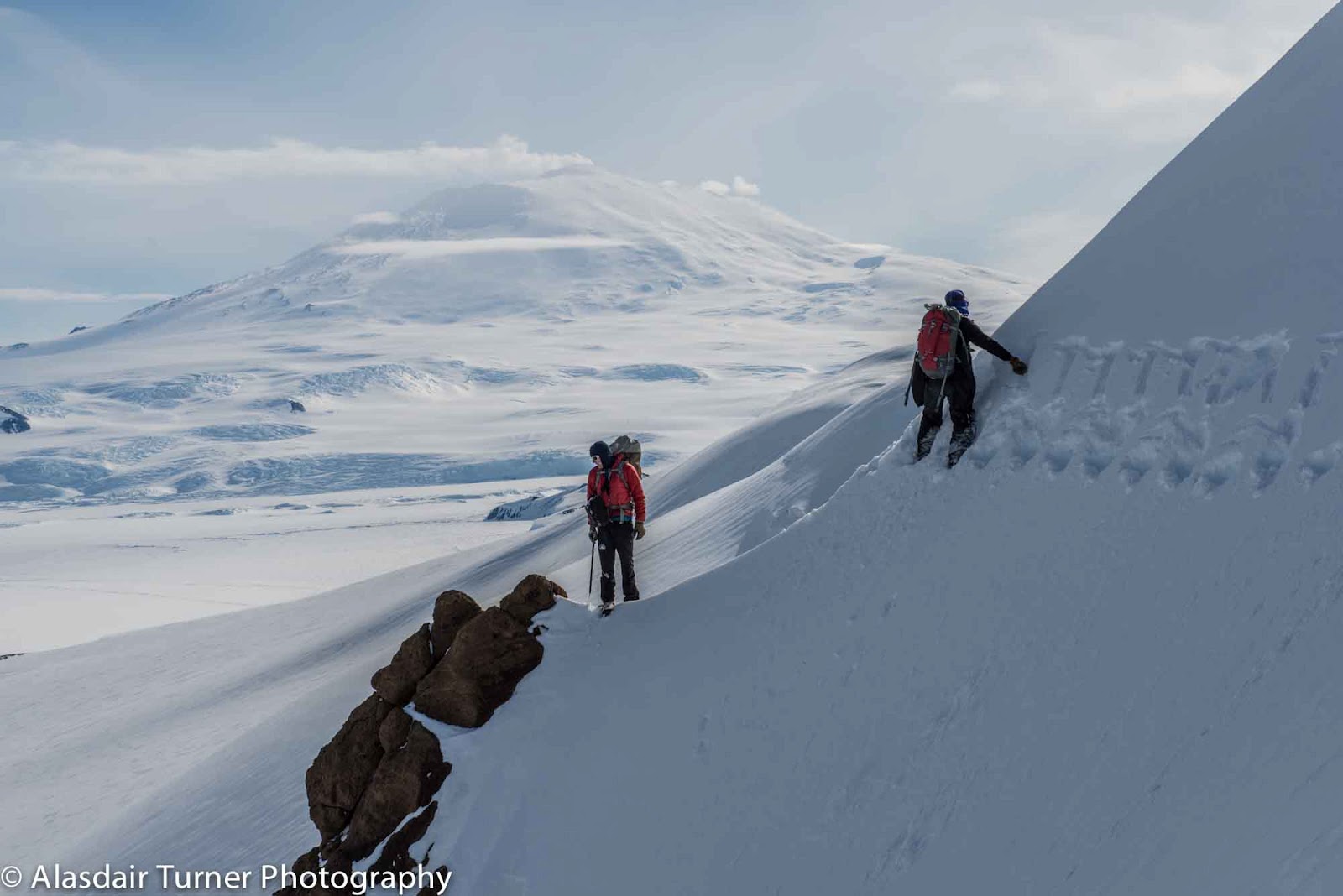
Traversing a snow slope on Castle Rock with Mt. Erebus in the background.
The Hagglunds early in the season when the sun still sets.
Driving a Hagglunds using radar only.
Even with radar navigation some route marking flags become casualties.
Testing the roof hatch of the Hagglunds.
Mt. Erebus Work
One of the best parts of our job is field support of science projects. Science grantees can request the help of FSTP for field work. In the 2012-2013 season, FSTP supported several field projects ranging from seal tagging, to placing very precise sensors at over 10,000 ft on the polar plateau. The job of FSTP is to ensure the safety of the scientists. The field project to which I was assigned was investigating micobiological life around the volcanic vents near the summit of Mt. Erebus. Mt. Erebus is a large active volcano that makes up a huge amount of the total area of Ross Island. It is also the most southern active volcano on earth and the second highest in Antarctica. Mt. Erebus is also home to one of the only permanent lava lakes on earth. Because Mt. Erebus is an active volcano it has many vents near the summit, many of which are located underneath the glaciers and snowfields. These vents melt the glaciers from the bottom up and create large cave systems all over the mountain. There are at least 50 known caves, some of which have never been entered. Access to these caves is highly restricted due to the sensitivity of life forms that could be in them. The goal for our group was to look for microbial life in the darkest parts of these caves. More information on this work can be found here. My job was to get them in and out of the caves safely, and, in some cases, to look for pristine, previously unentered caves from which to collect samples. This work involved finding the safest entrances, building anchors on the outside, belaying or lowering the scientists, ensuring they could climb back out, and monitoring the air for dangerously high levels of CO2.
Weather on Mt. Erebus can be exceptionally bad. Our first few days had us stuck inside a small hut while the temperatures dropped to -35F with winds up to 60 mph.
My evening accommodations on a windy day.
...and on an even windier day.
Inside the Lower Erebus Hut, desperation called for the use of a human waste bucket for the Thanksgiving turkey brine.
Many of the cave entrances are marked by large towers of ice. These are formed by steam freezing as it escapes into the incredibly cold Antarctic air. There are hundreds of these on the mountain and each is truly unique.
The large ice tower at the entrance to Sauna Cave.
Looking strait up inside one of the ice towers.
Ice towers near the Erebus hut.
Exploring the ice towers.
This tower, located above a small cave (haggis hole) with no recorded entries, was one of the sampling caves for the project.
In the past few years both BBC and National Geographic have spent time photographing inside the Erebus caves. There is no doubt that these caves are one of the most incredible places on the planet, and I feel truly lucky to have been able to work inside of many of them.
Exiting Warren Cave, the same cave captured in both the National Geographic and BBC visits.
Some caves are covered in crystals so fragile that even the lightest breath causes them to collapse.
Deep inside Warren Cave.
The one and only thing I truly have problems with is small spaces. I had to talk myself through this.
Exiting Mammoth Cave.
Light shines through the thin walls of Heroine Tower.
Warren Cave.
Crystal found in one of the caves.
The aptly named Imax room.
Inside Mammoth Cave, one of the largest on the mountain.
Inside Worm-tounge Cave
Not all of the work was inside the caves. One area of the mountain has surface temperatures so hot that any ice on it is melted off. This area also has unique biological life. We spent some time here locating and removing experiments that were left last season.
Sampling on Tramway Ridge.
The summit crater of Mt. Erebus is huge and active with a large lake of lava in the bottom. I was able to hike around the summit on two different occasions during my trip. There is something truly amazing about visiting active volcanos. It is difficult to give a sense of place in photos since because of the incredible sounds that were present when the images were taken.
Mt. Erebus summit crater.
The lava lake at the bottom of the crater.
Looking into the earth.
In the next several weeks I will add more info on what it was like to live and work at McMurdo Station.